Full Blog
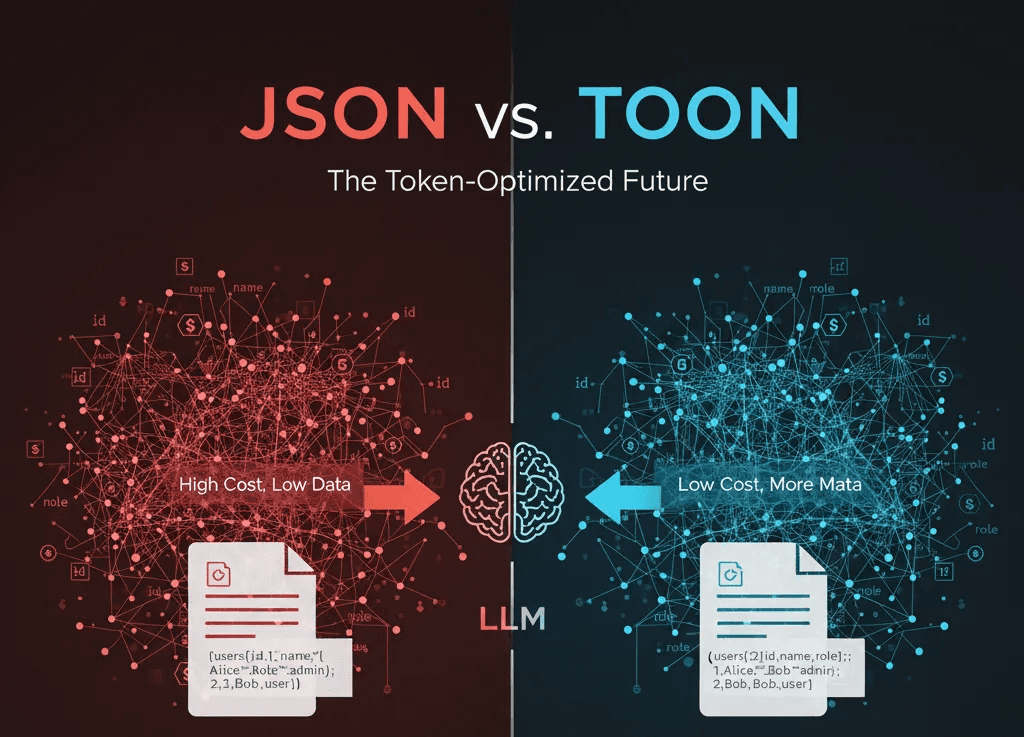
Last month, I spent ₹47,000 on AI API calls for a single client project. The worst part? I was only halfway through development.
The costs kept climbing every time I passed data to Claude or GPT-4. Customer records, product catalogs, analytics data—every dataset I fed into the AI ate through my token budget like termites through wood.
Then I discovered TOON (Token-Oriented Object Notation), and everything changed. Within a week, my token usage dropped by 52%. That ₹47,000 monthly bill? Now it's ₹22,560. That's ₹24,440 saved every single month.
Let me show you exactly how TOON works and why it's becoming the go-to format for smart AI developers in 2025.
What Exactly Is TOON? (Without the Technical Nonsense)
TOON stands for Token-Oriented Object Notation. Think of it as JSON's smarter, leaner cousin designed specifically for AI applications.
Here's the thing most developers don't realize: every character you send to an AI costs money. Every curly brace {}, every comma ,, every quotation mark " in your JSON data gets counted as a token. And tokens = rupees.
TOON eliminates this waste. It represents the same data with 30-60% fewer tokens by cutting out repetitive punctuation and organizing information like a smart spreadsheet instead of a verbose document.
A Simple Example That Shows the Difference
Let's say you're passing customer data to your AI:
Traditional JSON (51 tokens):
TOON Format (24 tokens):
Notice what happened? We went from 51 tokens to 24 tokens. That's 53% fewer tokens for the exact same information.
Now imagine you're passing 1,000 customer records instead of 3. Or 10,000 product listings. Or daily analytics for the past year. The savings multiply fast.
How TOON Actually Works: The Three Core Principles
1. Declare Once, Use Many Times
JSON repeats field names for every single record. TOON declares them once at the top:
JSON approach (repetitive):
TOON approach (efficient):
The more records you have, the more you save.
2. Minimize Punctuation
Every {, }, [, ], :, and " in JSON costs tokens. TOON uses whitespace and simple markers instead:
No curly braces around objects
No square brackets for arrays (except declaration)
Minimal quotes (only when needed)
Simple comma separation
3. Structure That AI Understands Better
Here's something surprising: AI models don't just save tokens with TOON—they actually understand it better.
Tests across multiple AI models showed TOON improves data retrieval accuracy by a few percentage points compared to JSON, thanks to its explicit structure that serves as "guardrails" for models.
Feature Breakdown: What Makes TOON Special
✅ Massive Token Reduction
Benchmarks show TOON reduces token counts by 30-60% versus JSON, with some real-world implementations seeing up to 68% savings on large datasets.
✅ Better AI Accuracy
The explicit structure with array lengths and field declarations helps models parse and validate data more reliably.
✅ Human-Readable Format
Unlike some compression formats, TOON remains easy to read and debug. It looks like a clean spreadsheet:
You can scan this quickly and spot errors immediately.
✅ Drop-In Conversion
You don't need to rebuild your entire system. TOON provides simple conversion tools:
JavaScript/Node.js:
✅ Works With All Major AI Models
TOON works seamlessly with:
OpenAI GPT models (GPT-4, GPT-3.5)
Anthropic Claude (all versions)
Google Gemini
Open-source models like Llama
When TOON Saves You the Most Money
TOON isn't always the answer. But in these scenarios, it's a game-changer:
🎯 Perfect For:
Database Query Results: When you're pulling customer records, orders, or analytics from databases
Batch Processing: Processing hundreds or thousands of similar records
Structured Data Analysis: Financial reports, inventory lists, user activity logs
Multi-Step AI Workflows: When data passes through multiple AI calls
High-Volume Applications: Customer support bots, content generation at scale
❌ Stick With JSON For:
Deeply Nested Data: Complex hierarchical structures with many levels
Non-Uniform Records: Each item has completely different fields
API Responses: External APIs still use JSON (convert after receiving)
Small Data Volumes: If you're only processing 10-20 records occasionally
Real Cost Calculator: Your Savings Estimate
Let's calculate your potential savings:
Your Current Setup:
Records processed per day: (e.g., 1,000)
Average tokens per record in JSON: (e.g., 2,500)
Token price per 1,000: (e.g., ₹1.6 for GPT-4)
Monthly Cost: (records × tokens × 30 × price) ÷ 1,000
With TOON (50% reduction):
Monthly Savings: Current Cost × 0.50
Example Calculations:
Daily Records | Current Monthly Cost | TOON Monthly Cost | Annual Savings |
|---|---|---|---|
100 | ₹12,000 | ₹6,000 | ₹72,000 |
500 | ₹60,000 | ₹30,000 | ₹3,60,000 |
1,000 | ₹1,20,000 | ₹60,000 | ₹7,20,000 |
5,000 | ₹6,00,000 | ₹3,00,000 | ₹36,00,000 |
These numbers assume 50% token reduction (conservative estimate) at ₹1.6 per 1,000 tokens.
Step-by-Step Implementation Guide
Step 1: Install TOON Library
For Python:
Step 2: Convert Your First Dataset
Take one of your existing data processing functions:
That's it. The conversion is literally one line of code.
Step 3: Measure Your Token Savings
Add simple logging to track before/after:
Step 4: Scale Across Your Application
Once you verify savings on one endpoint, roll out to:
Your highest-volume API calls first (maximum impact)
Batch processing jobs
Background tasks and scheduled jobs
Real-time features (as time permits)
Common Questions I Get About TOON
Q: Will my AI understand TOON format?
Yes. AI models treat TOON like familiar formats such as YAML or CSV once they see the pattern. The structure is self-documenting.
Q: Do I need to explain TOON format to the AI?
No, the structure is self-documenting and models parse it naturally once they see the pattern. Just send the TOON data directly.
Q: Can I convert TOON back to JSON?
Yes, TOON is completely lossless. You can convert back and forth without losing any data.
Q: What if my data changes structure frequently?
TOON works best with consistent structures. For constantly changing schemas, JSON might still be better.
Q: Is there any downside to TOON?
For deeply nested or irregular data, JSON might actually be more efficient. TOON shines with tabular, uniform data.
The Bottom Line: Your Action Plan
If you're building AI-powered applications and your token bills are climbing month after month, TOON is your answer.
Here's what you should do this week:
Audit your current AI spending: Check your OpenAI/Anthropic bills
Identify your highest-volume endpoints: Where do you process the most records?
Test TOON on one feature: Pick something non-critical to experiment
Measure actual savings: Track tokens before and after
Scale if it works: Roll out to more features based on results
Your AI bills don't have to keep climbing. Sometimes the biggest savings come from the smallest optimizations.
Stay Ahead of AI Development Trends
I test new AI tools and optimization techniques every week so you don't have to burn money learning the hard way.
Join my newsletter for:
Weekly AI cost optimization tips
Tool reviews with actual ROI numbers
Implementation guides you can use immediately
No hype, just savings
Over 5,000 developers are already cutting their AI costs with insights from my newsletter.
More Practical AI Guides
Looking for more ways to build better AI applications without breaking the bank? Check out my complete library of AI development articles covering everything from prompt optimization to architecture decisions that actually matter.